
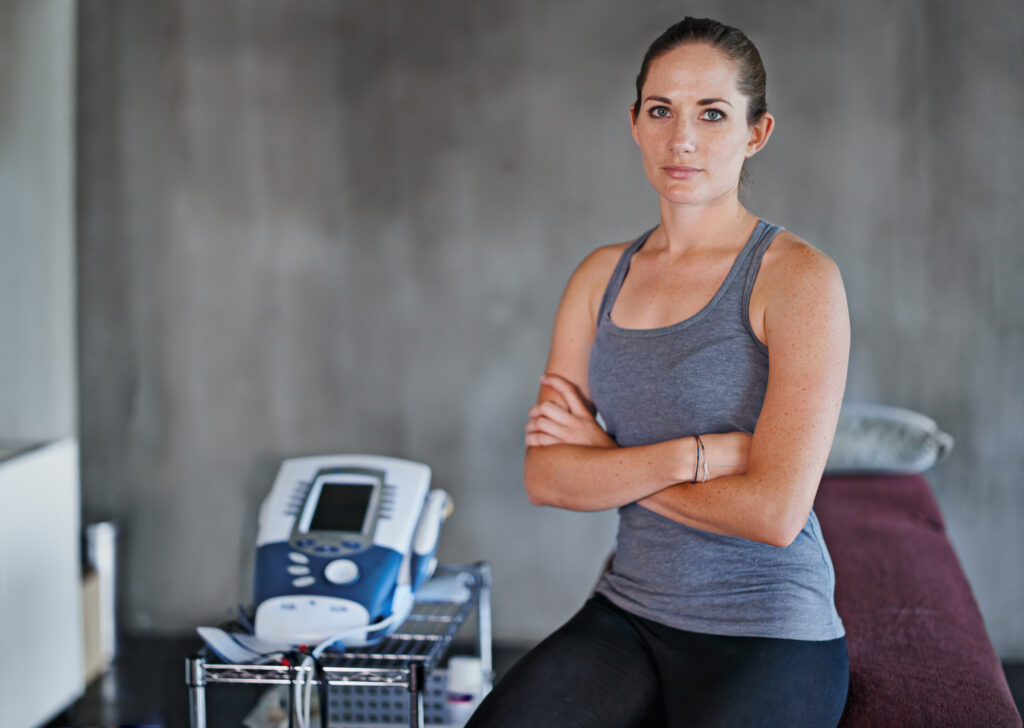
Everything You Need to Know About BFR Therapy at Femina PT — Pelvic Health, Postpartum, Hypermobility, Chronic Pain, Cancer Rehab, and Menopause
What is Blood Flow Restriction (BFR) Therapy?
Blood Flow Restriction therapy uses a medical-grade cuff to partially restrict venous return from a limb while maintaining arterial inflow during low-load exercise. This creates localized hypoxia and metabolite accumulation that activates anabolic signaling pathways (mTORC1, growth hormone, IGF-1) and recruits type II muscle fibers even at loads as low as 20–30% of one-repetition maximum (1RM). [1]
Across systematic reviews and randomized controlled trials, low-load BFR training has repeatedly produced strength and hypertrophy gains comparable to conventional high-load training performed at 70–85% of 1RM — a mechanism with direct relevance for patients who cannot tolerate heavy mechanical loading. [2]
At Femina Physical Therapy in Los Angeles, BFR is integrated into a comprehensive women’s health physical therapy framework. Every protocol begins with a full clinical evaluation. Cuff pressure is individualized using Limb Occlusion Pressure (LOP) — never a generic setting. BFR is never applied in isolation; it is one carefully selected tool within a broader clinical plan.
Femina PT clinicians hold advanced certifications in BFR therapy and pelvic floor rehabilitation. Our credentials are published on our website. We encourage you to review them before you book.
“BFR lets your muscles work smarter, not harder — and for patients whose bodies cannot tolerate conventional exercise, that changes everything.”
Why Femina PT’s Approach to BFR Is Different
Most physical therapy clinics in Los Angeles that offer BFR apply it as a general orthopedic add-on. At Femina PT, BFR is applied through an integrated women’s health lens that considers your pelvic floor function, hormonal context, pain neuroscience, and the specific clinical needs of the female body at every life stage.
Before booking BFR anywhere in Los Angeles, ask three questions: Is the cuff pressure individualized using Limb Occlusion Pressure? Is BFR integrated into a full treatment plan? Is the clinician specifically certified in BFR and has experience with your specific condition? At Femina PT, we advance our clinicians’ skills to conditions beyond orthopedic, looking through the lens of hypermobility, pelvic health, oncology rehabilitation and women’s health throughout the lifespan.
Who Benefits From BFR Therapy at Femina PT Los Angeles?
BFR is not a single-condition treatment. At Femina PT, we use it across a wide range of women’s health presentations because its ability to produce real strengthening results at low mechanical loads makes it valuable wherever conventional exercise is inaccessible, unsafe, or insufficient. Below is an overview of each population we serve, with a link to a dedicated, in-depth, fully-cited guide for each.
BFR for Pelvic Health and Pelvic Floor Dysfunction
Pelvic floor dysfunction — stress urinary incontinence, pelvic organ prolapse, diastasis recti, pelvic pain — is common and consistently undertreated. BFR allows us to build the hip, glute, and core strength that supports pelvic floor function, at loads that don’t aggravate sensitive or healing tissue. Every pelvic health patient at Femina PT begins with a comprehensive pelvic floor evaluation before any BFR protocol is introduced.
Read the full guide: BFR for Pelvic Floor Physical Therapy in Los Angeles — The Complete Guide
BFR for Hypermobility and Ehlers-Danlos Syndrome
Patients with hEDS, HSD, or generalized joint hypermobility need strength to protect unstable joints, but conventional strengthening protocols frequently exceed their safe load tolerance. BFR resolves this tension, producing meaningful strength at 20–30% effort in stable, mid-range positions. At Femina PT, hypermobility is a clinical focus, not a niche afterthought.
Read the full guide: BFR for Hypermobility and EDS Physical Therapy in Los Angeles
BFR for Chronic Pain and Pelvic Pain
For patients managing fibromyalgia, endometriosis, or central sensitization, conventional exercise often triggers flares. BFR provides a meaningful strengthening stimulus within most patients’ tolerance windows, and research on exercise-induced hypoalgesia suggests BFR exercise may directly reduce pain sensitivity through both local and central nervous system mechanisms.
Read the full guide: BFR for Chronic Pain and Pelvic Pain in Los Angeles
BFR for Postpartum Recovery
The standard 6-week postpartum clearance is not a rehabilitation plan. At Femina PT, postpartum care begins with a comprehensive pelvic floor evaluation and uses BFR’s low intra-abdominal pressure profile to rebuild lower body and core strength while protecting healing pelvic tissue and C-section incisions.
Read the full guide: BFR for Postpartum Physical Therapy in Los Angeles — 4th Trimester Recovery
BFR for Cancer Rehabilitation
Muscle loss during cancer treatment directly affects treatment tolerance and recovery. BFR is increasingly studied as a tool for preserving muscle at intensities compatible with active cancer care. At Femina PT, our oncology rehabilitation program is coordinated directly with your medical team, with individualized lymphedema assessment before any BFR application.
al team, with individualized lymphedema assessment before any BFR application.
→ Read the full guide: BFR for Cancer Rehabilitation in Los Angeles — Oncology Physical Therapy
BFR for Menopause and Bone Health
Declining estrogen in perimenopause and menopause reduces the body’s capacity for muscle protein synthesis and bone remodeling. Multiple randomized controlled trials in postmenopausal women now show BFR stimulates bone formation markers and improves bone mineral density indicators at low, joint-friendly exercise intensities.
Read the full guide: BFR for Menopause and Bone Health in Los Angeles
Is BFR Therapy Safe?
Across systematic reviews of BFR in musculoskeletal and neuromuscular rehabilitation populations, BFR has demonstrated a strong safety profile when properly administered, with adverse events comparable to or lower than conventional resistance training. [3]
At Femina PT, every BFR session begins with a thorough screening evaluation. Cuff pressure is individualized to your Limb Occlusion Pressure — never a generic estimate. BFR is not appropriate for everyone; absolute contraindications include active deep vein thrombosis, severe peripheral vascular disease, and open wounds at the cuff site. Your initial evaluation determines whether BFR is appropriate for you.
What to Expect at Your First BFR Appointment
Every patient at Femina PT begins with a comprehensive 85-minute evaluation. Your clinician reviews your complete health history, assesses your current functional baseline, identifies your goals, and determines whether BFR is appropriate and how it fits into your treatment plan. BFR exercise sessions themselves are 15–20 minutes, integrated into broader PT appointments.
Serving women across Los Angeles — Beverly Hills, West LA, Santa Monica, Culver City, Sherman Oaks, Studio City, Pasadena, Burbank and beyond. Telehealth consultations available.
Frequently Asked Questions
1. What is blood flow restriction therapy used for in women’s health?
A: At Femina PT in Los Angeles, BFR therapy is used for pelvic floor dysfunction, postpartum recovery, hypermobility and EDS, chronic pain, cancer rehabilitation, and menopause-related muscle and bone loss. BFR builds real strength at 20–30% of maximum effort, comparable to high-load training at 70–85% of 1RM. [2]
2. Is blood flow restriction therapy available in Los Angeles?
A: Yes. Femina PT in Los Angeles offers certified BFR therapy integrated with specialized women’s health and pelvic health care, applied using individualized Limb Occlusion Pressure protocols.
3. How do I know if a BFR provider in Los Angeles is qualified?
A: Ask whether cuff pressure is individualized using Limb Occlusion Pressure, whether BFR is integrated into a full treatment plan, and whether the clinician is certified in BFR and has experience with your specific condition. At Femina PT, we strive for the answer to all three to always be ‘yes’.
4. Is BFR therapy safe?
A: Systematic reviews of BFR across musculoskeletal rehabilitation populations report a favorable safety profile when cuff pressure is individualized and applied by a trained clinician. [3]
Ready to experience the Femina PT difference? Book your BFR evaluation in Los Angeles today!
References (Peer-Reviewed Sources)
[1] Hughes L, Patterson SD, et al. Blood flow restriction exercise: considerations of methodology, application, and safety. Front Physiol. 2019. pubmed.ncbi.nlm.nih.gov / PMC6139300
[2] Effects of Blood Flow Restriction Training on Lower Extremity Maximum Dynamic Strength and Isokinetic Muscle Strength: A Systematic Review and Meta-Analysis. 2024. ncbi.nlm.nih.gov/pmc/articles/PMC12360924
[3] Jiménez-Martín P, et al. Effectiveness of Blood Flow Restriction on Functionality, Quality of Life and Pain in Patients with Neuromusculoskeletal Pathologies: A Systematic Review. Int J Environ Res Public Health. 2023. ncbi.nlm.nih.gov/pmc/articles/PMC9858892