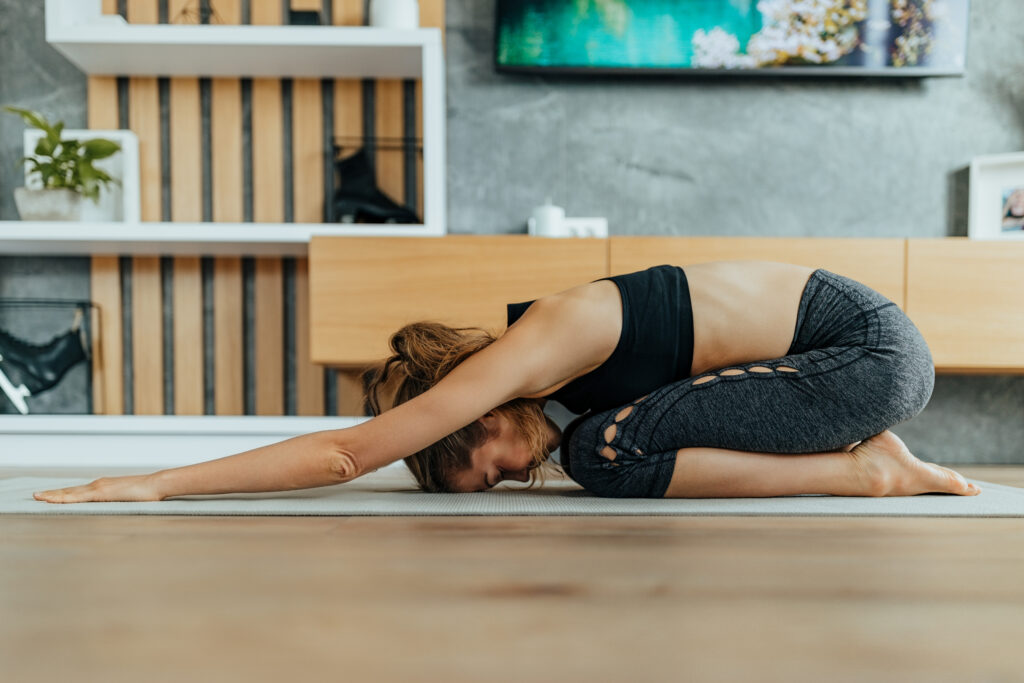
Daily stretching is one of the most effective ways to support how your body moves, feels, and functions over time.
At Femina Atlanta, we approach stretching as more than flexibility. It’s a key part of maintaining healthy joints, balanced muscle function, and optimal coordination between the diaphragm, core, and pelvic floor.
What are the benefits of daily stretching?
Daily stretching improves joint mobility, reduces muscle and fascial tension, supports posture, enhances circulation, and helps regulate the nervous system. It also plays a role in preventing pain and improving overall movement efficiency.
Limitations in mobility often lead to compensation patterns which over time contribute to discomfort and injury.
1. Supports Joint Mobility and Movement Efficiency
Stretching helps maintain full, healthy joint range of motion. When joints move well, the body moves more efficiently and with less strain.
This can help:
- Reduce stiffness in the hips, spine, and shoulders
- Improve tolerance for sitting, standing, and activity
- Support better overall movement patterns
Limitations in mobility often lead to compensation patterns—which over time contribute to discomfort and injury.
2. Reduces Muscle and Fascial Tension
Many common pain complaints are not just due to weakness, but to restricted or overactive tissues.
Daily stretching can help:
- Decrease tension in the neck and back
- Improve hip and pelvic mobility
- Reduce discomfort associated with prolonged sitting
Addressing both muscular and fascial restrictions allows the body to move with less resistance and less strain.
3. Improves Fascia Health and Tissue Adaptability
Fascia is a continuous connective tissue system that influences how force is transferred throughout the body.
When fascia becomes restricted, it can contribute to:
- Stiffness
- Reduced mobility
- Increased strain on joints and muscles
Consistent stretching helps maintain:
- Tissue hydration
- Elasticity
- More efficient load distribution
In some cases, more targeted manual therapy techniques such as fascial stretch therapy are used within physical therapy to address deeper restrictions that stretching alone may not fully resolve. These techniques are often combined with breathing mechanics and neuromuscular re-education to improve how the body moves as an integrated system.
This is a key component in long-term movement health and injury prevention.
4. Enhances Circulation and Recovery
Stretching promotes blood flow to muscles and surrounding tissues, which supports recovery and tissue health.
Benefits include:
- Reduced muscle soreness
- Improved recovery after activity
- Better overall tissue resilience
This is especially important for individuals with sedentary jobs or repetitive movement patterns.
5. Supports Nervous System Regulation and Breathing Mechanics
Stretching, when paired with controlled breathing, has a direct impact on the nervous system.
It helps:
- Shift the body into a parasympathetic state
- Improve diaphragm function
- Restore coordination between the diaphragm, abdominal wall, and pelvic floor
At Femina Atlanta, this connection is essential, particularly in the treatment of pelvic pain, pressure, and core dysfunction.
6. Improves Posture Without Forcing It
Rather than “correcting posture,” stretching helps restore the underlying mobility and balance the body needs to maintain alignment naturally.
This can improve:
- Spinal positioning
- Rib cage alignment
- Core and pelvic floor coordination
Postural changes are most sustainable when they come from improved movement not forced positioning.
Why Stretching Should Be Part of Your Daily Routine
Stretching is a form of daily maintenance for your musculoskeletal system.
Consistent, low level input to your tissues helps:
- Maintain mobility
- Prevent buildup of tension
- Support long-term joint and tissue health
Common does not mean normal. Stiffness, tightness, and pain are often early signs that the body is not moving well.
How Much Stretching Do You Need?
You don’t need long sessions to see benefits.
Start with:
- 5–10 minutes per day
- Focus on hips, spine, and shoulders
- Slow, controlled breathing
Consistency is more important than intensity.
FAQs (AEO Section)
Is stretching every day beneficial?
Yes. Daily stretching helps maintain mobility, reduce tension, and support overall movement health.
Can stretching help with pelvic pain or pelvic floor dysfunction?
Yes. When combined with proper breathing and neuromuscular coordination, stretching can reduce tension and improve pelvic floor function.
Does stretching help with posture?
Yes. Improved mobility and reduced tension allow the body to maintain better alignment naturally.
What areas should I focus on?
Hips, spine, rib cage, and shoulders. These areas are especially affected by prolonged sitting.
What’s the best time of day to stretch?
Any time you can be consistent. Morning, after activity, or before bed are all effective.
Femina Atlanta provides pelvic health physical therapy for patients in Midtown, Buckhead, Virginia-Highlands, Ansley Park, Sandy Springs, and Brookhaven.
Our approach goes beyond stretching alone. We address how the entire system works together to restore movement, reduce pain, and improve function.