
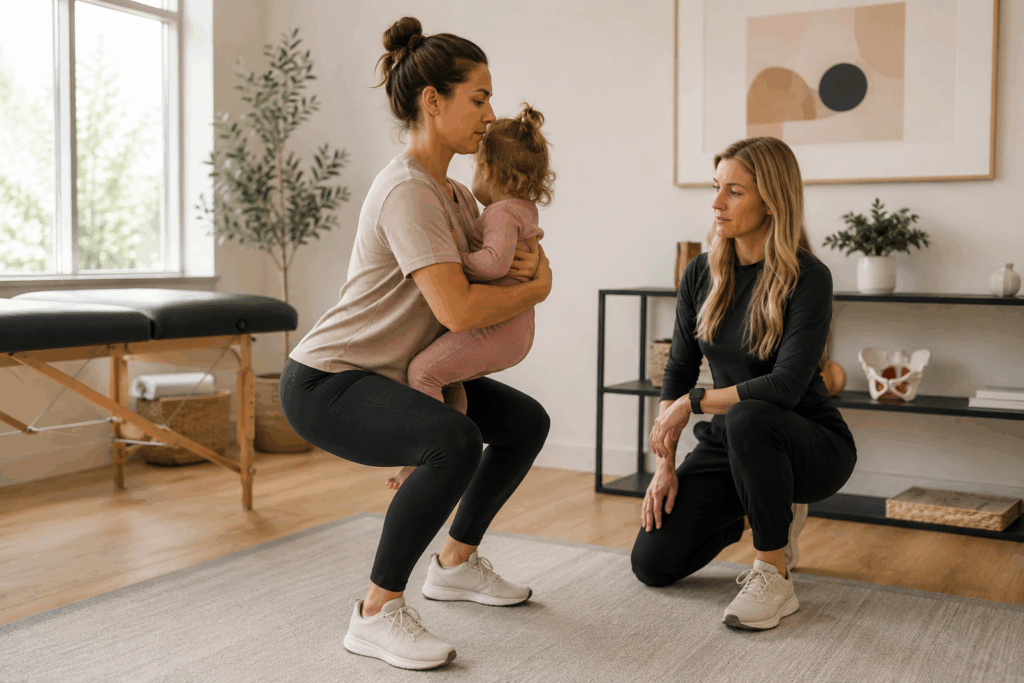
If you’ve ever thought,
- “Why can’t I feel my glutes after my pregnancy?”
- “Why do my hamstrings always feel tight”?
- “Why does my back hurt when I lift my baby?”
You’re far from alone. In fact, all of these are very common questions we get asked in pelvic floor physical therapy.
Many people assume it means their glutes are weak. But that is often not the whole story. A lot of the time, the glutes are simply contributing less than they should while other muscles quietly begin taking over.
Your body doesn’t stop moving when one muscle isn’t pulling its weight. It adapts.
- The hamstrings work harder.
- The low back works harder.
- The pelvic floor becomes tense and can’t relax.
At first, these compensations are incredibly effective. They allow you to continue walking, exercising, lifting your children, climbing stairs, or playing sports without realizing your movement strategy has changed.
The challenge is that what begins as a short-term solution often becomes your body’s default pattern.
Over time, the muscles doing too much work become fatigued, irritated, and painful, while the muscles contributing less become even more difficult to recruit. Healthy movement depends on multiple muscles sharing the workload rather than relying on one or two muscles to do everything. We see these movement patterns frequently in women seeking pelvic floor physical therapy in Atlanta, particularly during the postpartum period and in those experiencing chronic pelvic pain.
This doesn’t only affect athletic performance. It can influence hip pain, persistent low back pain, SI joint discomfort, postpartum recovery, and pelvic floor dysfunction.
Your Brain Cares More About Completing the Task Than Which Muscles Do It
One of the biggest misconceptions is that your brain is constantly trying to use the “correct” muscles.
It isn’t. Its primary goal is accomplishing the movement.
If standing up, climbing stairs, or picking up your child can be completed by asking the hamstrings, pelvic floor muscles and lumbar muscles to do a little more work, your nervous system is often perfectly happy to do exactly that.
The brain prioritizes success. Not perfection.
That adaptability is one of the greatest strengths of the human body. It’s also one reason compensation patterns can persist long after an injury has healed, pain has improved, or postpartum tissues have recovered.
What Do People Mean by “Glute Inhibition”?
You may have heard the term “glute inhibition.” While it’s commonly used, it doesn’t necessarily mean your glutes have completely turned off. A more accurate way to think about it is under recruitment or not contracting as much as they should be.
Your glutes are still working. They’re simply contributing less than they should for the demands being placed on your body.
In some people, it’s not just how much the glutes contribute that changes. The timing changes as well.
Muscles that should primarily be assisting the movement and stability, such as the hamstrings or muscles surrounding the pelvis and low back, begin contributing earlier than the glutes. Over time, that altered recruitment pattern can become your body’s default movement strategy, making it increasingly difficult to engage the glutes when you want to. As a result, neighboring muscles begin sharing more of the workload.
Sometimes that’s appropriate. When it becomes your normal movement strategy, however, problems often begin to develop.
Why Do the Hamstrings Take Over?
The hamstrings and glutes are partners. Both help extend the hip during walking, climbing stairs, standing from a chair, squatting, and lifting.
When the glutes contribute less the hamstrings naturally increase their effort to accomplish the same movement.
Initially, this works remarkably well. Over time, however, the hamstrings begin performing a job they weren’t designed to do. This is one reason people frequently describe their hamstrings as constantly tight despite stretching them for months.
Sometimes they aren’t actually short. They’re simply overworked.
If stretching only provides temporary relief, it may be worth asking whether the hamstrings are truly the problem or whether they’re compensating for a movement strategy that’s asking them to do too much.
Why Does This Matter for Pelvic Health?
Your glutes play an important role in helping maintain pelvic stability during everyday movement. When they’re under recruited or fire at the wrong time, your body doesn’t simply become unstable.
It adapts.
Sometimes that means the muscles surrounding the lumbar spine increase their activity to help stabilize the pelvis. Over time, that additional demand can contribute to low back fatigue, stiffness, or pain, even though there may be nothing structurally wrong with the back itself.
The pelvic floor can respond in a similar way.
In addition to supporting bowel, bladder, and sexual function, the pelvic floor also contributes to pelvic stability. When other muscles aren’t providing enough support, the pelvic floor may gradually increase its activity in an effort to create more stability.
Initially, that strategy can be helpful.
Over time, however, increased muscle activity may become the body’s default. Instead of contracting and relaxing when appropriate, the pelvic floor may remain more active than necessary, contributing to persistent muscle tension and making it more difficult for the muscles to fully relax. For some people, this may become one of several factors associated with hypertonic pelvic floor dysfunction.
Pelvic pain is rarely explained by one muscle or one movement pattern. As you’ve likely seen if you’ve struggled with chronic pelvic floor tightness, symptoms often develop because several systems are interacting rather than one tissue working in isolation. This is why pelvic floor physical therapy extends well beyond evaluating the pelvic floor itself.
Assessment includes how you walk, squat, balance, breathe, and coordinate your hips, trunk, and pelvis during functional movement. Treatment may involve reducing unnecessary muscle tension, improving muscle recruitment, restoring more efficient movement patterns, and helping your nervous system develop strategies that create pelvic stability without relying on constant muscle guarding.
Can You Just Strengthen Your Glutes?
Strength is important. But strength alone doesn’t always change the way your body moves. A muscle can be perfectly capable of generating force during an exercise and still contribute less than it should during walking, climbing stairs, squatting, lifting, or other everyday activities.
That’s because movement depends on more than strength. It also depends on coordination. The right muscles have to contribute at the right time, in the right amount, while working together with the rest of the movement system. It’s a dance.
If your body has relied on the same compensation patterns for months or years, simply making the glutes stronger may not automatically change the way you move. Your nervous system often continues using familiar movement strategies. At Femina Atlanta, we often see this develop as a protective mechanism for women living with chronic pelvic pain.
Pelvic health physical therapy needs to focus on helping your body recruit the glutes more effectively during functional movement while reducing unnecessary compensation from muscles that have been working overtime. For people with pelvic pain, this often includes improving how the hips, trunk, and pelvic floor coordinate during everyday activities so no single muscle has to constantly create stability on its own.
The goal isn’t simply stronger glutes. It’s restoring a movement strategy that allows your body to move more efficiently with less unnecessary muscle tension.
Frequently Asked Questions
Why can’t I feel my glutes during exercise?
Many people compensate with their hamstrings, low back, or other muscles. Your glutes may still be working, but they may not be contributing as as much and as effectively as they should during the movement.
Does not feeling my glutes mean they’re weak?
Not necessarily. A muscle can be strong yet still contribute less than expected during functional movement. Under recruitment and weakness are not the same thing.
Why do my hamstrings cramp during bridges?
This commonly occurs when the hamstrings are taking on more of the workload because the glutes are contributing less efficiently. It doesn’t always mean the hamstrings are the problem, it often means the hamstrings are trying to do the work of the glutes.
Can glute under recruitment contribute to pelvic pain?
It can be one contributing factor. Changes in movement coordination and stability may increase the demands placed on the pelvic floor, hips, and surrounding muscles, particularly in people already dealing with pelvic pain.
How can pelvic floor physical therapy help?
Pelvic floor physical therapists evaluate much more than the pelvic floor itself. Treatment may include improving movement coordination, reducing unnecessary muscle tension, retraining muscle recruitment, and helping the hips, trunk, pelvis, and pelvic floor work together more efficiently. Treatment also often includes balancing how the diaphragm, core and pelvic floor work together.
References
- Hodges PW, Sapsford R, Pengel LH. Postural and respiratory functions of the pelvic floor muscles.
- Comerford MJ, Mottram SL. Movement and stability dysfunction: Contemporary developments.
- Lee D. The Pelvic Girdle: An Integration of Clinical Expertise and Research.
- van Dieën JH, Reeves NP, Kawchuk G, van Dillen LR, Hodges PW. Analysis of motor control in patients with low back pain.
- Kolar P, Sulc J, Kyncl M, et al. Stabilizing function of the diaphragm and coordinated movement patterns.
- Neumann DA. Kinesiology of the Musculoskeletal System: Foundations for Rehabilitation.